Sometimes lots of good ideas just hit you at once. Indeed, it happens to me quite often that I'm overwhelmed with all the good things I want to do, the things I want to plan, the books I want to read, and the things I want to write. The main problem is they can't all possibly be done at once, so it just leaves me in a frantic rush to do as much as I possibly can and then fizzles out by the time my alarm goes off the next morning and I don't feel like getting out of bed. My goal here, writing today, is simply to write a few scatter thoughts that have been on my mind, each worthy of a blog post in their own right. A big problem for me is that I am too meticulous in my writing. I try almost too hard to express precisely what I want, when in fact no words will be perfect in describing what it is I'm talking about. I spend too much time trying to find the perfect phrase, etc. So I am trying to do the exact opposite right here and now. I'm just simply going to write. I hope my scattered thoughts you might find interesting, but in someways I just want to get them down on (virtual) paper. It's quite possible that this way of writing might just be the perfect way to make ideas stick. Peter Kreeft, philosopher at Boston College, thinks that Blaise Pascal's Pensées is one of the best books ever written precisely because it is unfinished and scattered. If it had been completed and followed a perfectly logical progression, it would have been ruined. So God in his mercy killed Pascal before his book was finished. I don't know whether I agree with Kreeft, but Pensées is pretty good and if I volunteer to write down unfinished thoughts, maybe God will spare my life.
One things that's been on my mind is the idea of self forgetfulness. There is another answer to the riddle which I proposed in my last post. The Self. The only way to find one's self is to completely forget one's self. Get so caught up in what you are doing, that you become completely unselfconscious. Self-consciousness is generally a bad sign. If you are self conscious, you can never truly be yourself in social situations. If you are self conscious about the kind of job you are doing, you are probably doing a bad job. To paraphrase Kreeft, no one ever made a good impression by trying to make one. Just think about the absentminded genius. They are so lost in their work, that they forget to take care of themselves or they even forget where they are. Learning to become disinterested to even one's own desires and happiness is moving swiftly down the road to joy.
I love the change of the seasons. Much to my joy, I've discovered that the smell and feeling of Fall is the same in London, England as it is in Southeast Michigan, or South Bend, Indiana. The first days of any change in season are always so wonderful. The smell brings back memories of the same time in years past, as does the feel of the wind or the weather. Running around the nearby park has brought back memories of playing high school soccer on windy days in October. It reminds me of my backyard during fall, both in Michigan and even dimly in Indiana, though I was seven or younger at that time. I think of playing kickball in the backyard with friends. I think of the leaves falling around the lakes at Notre Dame, and driving up Notre Dame avenue just after Fall break, the golden dome in view. I am reminded of beautiful faces. Fall makes me feel lovesick and homesick at the same time.
Friends. It's struck me that those friendships which I most especially value are those which make me feel completely humbled. I've been blessed through my life to meet many wonderful people. Sometimes I just wonder to myself in sort of awe, "How is it that I am so lucky?" There isn't anything that I could possibly have done to make myself worthy of this friendship. And so I experience their friendship as pure gift. Friendship is a gift you give, but more importantly is a gift that you receive. When I go wrong is when I think "shouldn't these people want to be my friend. Yeah, I've got lots of great personal qualities." The reality is that I do not deserve to have friends and that I can't make anyone be my friend. It is pure gift. It's about standing in receptivity to the gift of another person. For a Christian, I think friendships are particularly important because they teach us how to be a receiver, the relationship we always stand in towards God.
I think this bit about friendship ties in nicely with the theme of self-forgetfulness. In a true friendship, the self-consciousness of meeting someone has fallen away. You no longer think about thinks like "What sort of questions should I ask this person? What should I say? What do they think of me?" Ironically, it is losing this self-consciousness in relationship that allows one to be oneself and to actually share more of oneself. Deep friendships have reached the point where sharing deep truths about one's self is easy and natural. It's as though the barrier of the self has broken down.
What about love? (Upon reflection, that questions terribly deals with the ambiguity of our language. Let me rephrase: "What about Eros?") I have found it difficult to think about marriage in terms of this ethic of self-forgetfulness. In my present thinking, I haven't been able to see the married state as something which does enough to "draw one out of The Self." I'm not saying the problem is with marriage, but rather the problem is with my own inadequacy. When I look a marriage, I see a good thing, a beautiful thing. There are many things I find attractive about that state of life. But were I drop everything and get married today, I would be pursuing it as something that I want, something that I think would make me happy. I want this woman to love me and I want to love her and spend time with her because that gives me joy. Thought of like this, that is hardly a drawing out of the self. But like I said the problem is with me. I've never reached the state (or if I have, I don't remember it particularly well), where I've been so transported by the joys of Erotic love that my own desires have melted away and my self so forgotten so that the 'I' becomes 'we.' I've not reached that place where lifelong love and commitment becomes not something that I want as I, but as some completely natural and seemingly inevitable next-step to join together a selfless 'we.' Perhaps I'm romanticising love too much. However, it does make perfect sense to me when older, happily married couples say that "We've more in love now that when we were first married." It's because they lived through so much together, and have been required to make so many sacrifices, that they most certainly had to forget themselves and their own wants. I mean they have made sacrifices not in a petty, "We'll do what you want because it makes me feel good to give you what want," sort of way, but in a way which requires real pain.
(Edit: I don't mean to introduce a discontinuity between friendship and Eros. Indeed, I think a true romance will inspire a feeling of humility just as a true friendship does, and that romantic love will be experienced as a gift, just as friendship is. I also think they pose a similar challege, in that both are often initially sought in response to a personal desire, but in both that desire can be transcended. What I wrote about Eros could easily have been written by someone else about friendship. Perhaps, I should just retract the whole paragraph. Nevertheless, I think it is true to say that perhaps because there is greater attraction to Eros and the possibility for self-transcendence is even higher, it is more difficult to initially escape the self-seeking element. The reflection above betrays the subjective state of the author and should be understood accordingly.)
The last paragraph took me an outrageous amount of time to write compared with the rest of the post. If it's the worst paragraph, it certainly proves Kreeft's theory. In anycase, I hope I can return to a more free-flowing style for the last few thoughts here. The first is, when thinking about self-forgetfulness and such over the past few days, its occured to me that perhaps I should blog less. While blogging might initially seem more other-directed than simply journaling, for me this is entirely not true. Way too often I am motivated to blog in part by a vain desire to have others admire what I've writen, combined with a need to share what I am thinking. But perhaps what is even more annoying, is that when I have an awesome thought, I can automatically think to myself "Boy, that would make a great blog post. Won't people think I'm awesome for having such a great thought." That spoils the thought as a thought in its own right, and is pretty vain to boot. Although, if I decided just to journal about these thoughts, I'll probably still have an intrusive complusion to journal. Perhaps the easiest solution to allay some of these qualms is to just check my Blogger stats much less often.
Finally, related to the blogging/thought hoarding problem, I've often gotten frustrated in my past trying to obsessively seize with my mind beauty things or cool experiences. The worst is when I have a camera, which becomes an extension of my mind, and I begin to take pictures complusively, trying to save the memory of what is there. Not that I discourage picture-taking, but I've found the enjoyment of a thing is often spoiled by trying to enjoy it. Better just to be receptive and to let things come as they are. Then you'll be surprised what you can enjoy if you are not trying.
Later Dudes (and Dudettes for those feminists who claim that the word 'dude' excludes 'dudettes.' Actually, why do some feminists insist that terms like 'waiter' works now for both 'waiter' and 'waitress,' but get really mad if I don't specify 'woman' in addition to the term 'man?' Perhaps they would get offened that I specified 'dudettes.' I'm so confused. And I wish everybody would stop making generalizations.)!
Showing posts with label Pascal. Show all posts
Showing posts with label Pascal. Show all posts
Tuesday, October 11, 2011

Thursday, July 28, 2011
Cosmos
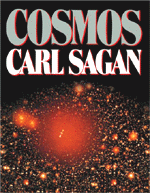
Cosmos comes from a Greek word meaning order. It is the opposite of Chaos. There is a beautiful orderliness to the universe. There are fractal patterns: moons orbiting planets orbiting stars orbiting galaxies orbiting each other. There are billions and billions of stars and galaxies, and the same laws of nature which apply everywhere. And most wonderful of all there is at least one place in the universe where matter has become alive. Humans beings, creatures made from matter, from the same protons and electrons that make up the stars and were once in the stars, are conscious and able to ponder their own destiny. What wonders!
Yet, Dr. Sagan's book is not just a search for order but for meaning. In fact, this is largely how Sagan views the human endeavor in space. Our current forays into space parallel the great historical voyages of discovery. He writes:
 |
| The Eagle nebula |
The surface of the Earth is the shore of the cosmic ocean. From it we have learned most of what we know. Recently, we have waded a little out to sea, enough to dampen our toes or, at most, wet our ankles. The water seems inviting. The ocean calls. Some part of our being knows this is from where we came. We long to return.
If we discover intelligent life on another planet, Sagan thinks we will have a better grasp on what it means to be human. As we continue to learn about the expanse of the universe, we learn what it means to be live on earth. We learn that such a habitable world is precious, but that it pales in comparison with the rest of the universe. As we seek to learn more about the universe, we seek to learn more about ourselves.
Meaning. Perhaps this is the thing that people are searching for. We want to know what our lives are all about, what life itself is all about. When something captures our imagination, be it a sunset, a song, or a beautiful face, and we feel that twinge of restless longing that can never quite be satisfied, it's as if we're on the verge something profound. It seems like the meaning we are looking for is finally within reach, but, like the end of the rainbow, it always remains just ahead of our outstretched hands. And so we keep searching.
Thoughts of space, time, and the cosmos are tantalizing. They are exciting. They fill us with wonder. It's tempting to think that we can find the answers to some of life's most persistent questions out there among the stars. Science has worked wonders and given humans so much. With it, we have fed the masses, eradicated disease, and traveled around the world and into space. Science has answered questions about gravity, the lives of animals, and how our own minds work. What can't science do? Yet, Palmer Joss (character in the film Contact based on the Sagan novel by the same name) reminds us that "Ironically the thing that people are most hungry for, meaning, is the one thing that science hasn't been able to give them."
No matter how long we listen with our radio telescopes among the stars, no matter how many light-years we travel, no matter how much our hearts ache as we gaze at the night sky, we will never find meaning there. Sagan is fascinating, inspiring, and uplifting in his book as he searches for order and meaning. He is also dead wrong. Science can say nothing about the questions that matter most. Allow me an example. It is a scientific fact that if you were randomly inserted anywhere in the universe, the odds that you would be on or near a planet would be less than 1 in 10^33. The odds that you randomly select a place in the universe where there is life is considerably less, much less intelligent life. It would be fair to say that beings such as humans are rare. This is a fact of which modern science makes us acutely aware. Yet Sagan goes on to write, "Every one of us is, in the cosmic perspective, precious. If a human disagrees with you, let him live. In a hundred billion galaxies, you will not find another." I don't disagree a bit, but his statement is one of pure philosophy. He assumes that because something is rare it is therefore precious and ought to be preserved. But mightn't it be the other way around? Might not humans be like ugly recessive mutations in a universe meant to be perfectly smooth and uniform? Wouldn't it then be better if we blew our tiny planet up and squashed conciousness out of existence? Science or nature by itself tells us nothing about the value of our lives. It's worth repeating here part of the GKC quote from my last post. (I think it rather apt here. Sorry for the redundancy.)
Nature does not say that cats are more valuable than mice; nature makes no remark on the subject...We think the cat superior because we have (or most of us have) a particular philosophy to the effect that life is better than death. But if the mouse were a German pessimist mouse, he might not think that the cat had beaten him at all. He might think he had beaten the cat by getting to the grave first...It all depends on the philosophy of the mouse. You cannot even say that there is victory or superiority in nature unless you have some doctrine about what things are superior. You cannot even say that the cat scores unless there is a system of scoring. You cannot even say that the cat gets the best of it unless there is some best to be got.
Orthodoxy, Chapter VII, The Eternal Revolution
If Sagan's logical leap from saying that life is rare to saying that life is precious seems natural to you, that is because you and he are both humans. The conclusion does not come from science, but from the very thing that makes us human. To paraphrase Pascal, our heart tells us what our reason cannot. Science is by no means useless in the pursuit of ultimate truth. The facts of science can challenge our worldview and help us to think in new ways. Philosophically, it did make a big difference when we realized that the earth was not the center of the universe. It makes a difference that our universe is big and not small. It makes a difference that there are beautiful, unexplored worlds out there. It makes a difference that the human spirit is not bounded to this planet alone. But these facts only make a difference because humans are humans. We are influenced by the world we inhabit. At the end of the day, the answers are not going to be found out there, but in the depths of our human hearts. It is ironic that we should look billions of light years away in search of ourselves.
Tuesday, June 21, 2011
Concerning Aliens, Faith, Reason, Memory, and Religious Experience
The following gem comes from the movie "Contact" based on the novel by Carl Sagan. A video of the scene from which the dialogue is taken can be found here.
There is a difficulty, however, in communicating a faith which stems from experience. It is the experience itself that creates certainty in the believer. Reason cannot verify the experience, but somehow the heart knows what it has experienced is true. As Pascal said, "The heart has its reasons, which reason does not know." But if faith comes from experience, my personal experience will probably not be convincing to you, no matter how vividly I feel it. Recall Dr. Arroway's line: "I wish I could share that. I wish, that everyone, if only for one moment, could feel that awe, and humility, and hope! But ... that continues to be my wish."
In reflecting on the relationship between faith and reason, I've thought that perhaps faith ultimately has to come from experience, or something like it. By some means or another, the heart has to be moved to believe. Reason can't give us faith, because, without any premises from which to start, it is impossible to prove anything by reason. We cannot even prove that we are awake instead of dreaming. Again I turn to Pascal:
I want to suggest that memory is indispensable for having faith in a universe where God's presence isn't overwhelming. Experiences, like Orual seeing the palace, are isolated to a particular point in time. Memory allows those experiences to be brought into the present. This is part of the reason memory plays such an important role in the Judeo-Christian religious tradition. The Jewish feast of Passover is a memorial of the original Passover meal, when the Jewish people were freed from slavery and bondage in Egypt. When Jews today celebrate the Passover meal, they understand they are not simply reenacting the meal that saved their ancestors thousands of years ago. Rather, they understand that they are participating in the ongoing saving action of God, who saves them personally in the here and now. It is in a similar light that Christians understand the exhortation of Christ to offer bread and wine "in memory of me." The act of commemorating the Last Supper is understood as something which brings Christ's once-and-for-all, saving sacrifice on the cross into the present, so that the merits of this action can be communicated to the believer.
Perhaps we've all had those moments of great clarity or insight, when we finally we able to see the meaning in all the work we've been undertaking. Or we've had that moment when we're sure that God exists because of some great grace that we've received. Some of the great saints, the mystics, report having experiences in which they were indescribably enlightened. St. Ignatius reported mystical experiences that were so powerful that even if the Bible didn't exist and he had no other source of religious knowledge, he would have willingly died for the faith in light of his experience. At the same time, the mystics, who had such vivid experiences of God, were often the ones who went through the greatest experiences of isolation, the dark night of the soul. How could they have possibly gotten through those times? The answer must be memory. Their only source of hope was the memory of the Lord's blessings, the trust that at some point they would be brought from darkness into light. Though to a lesser extent, I reckon we all go through moments when life seems meaningless and lonely. These moments are the true test of faith, when a trusting leap is required. It is then we are called to remember.
Faith is an inexhaustible subject for reflection. I in no way intend to be definitive about the relationship between faith, experience, and memory. Perhaps, I miss the mark in saying that faith comes from experience and intuition. But, I do believe that faith is a gift. It is not reducible to reason, but is something, like love, which goes far beyond our reason.
- Senator: You come to us with no evidence, no record, no artifacts. Only a story that, to put it mildly, strains credibility... Are you really going to sit there and tell us that we should just take this all on faith?
- Ellie Arroway: Is it possible that it didn't happen? Yes. . . . As a scientist I must concede that. I must volunteer that.
- ...
- Mr. Kitz: Then why don't you simply withdraw your testimony and admit that this journey to the center of the galaxy, in fact, never took place?
- Ellie Arroway: Because I can't. I had an experience... I can't prove it, I can't even explain it, but everything that I know as a human being, everything that I am tells me that it was real! I was given something wonderful, something that changed me forever... A vision of the universe that tells us, undeniably, how tiny, and insignificant and how ... rare, and precious we all are! A vision that tells us that we belong to something that is greater than ourselves, that we are not — that none of us — are alone! ... I wish I could share that. I wish, that everyone, if only for one moment, could feel that awe, and humility, and hope! But ... that continues to be my wish.
There is a difficulty, however, in communicating a faith which stems from experience. It is the experience itself that creates certainty in the believer. Reason cannot verify the experience, but somehow the heart knows what it has experienced is true. As Pascal said, "The heart has its reasons, which reason does not know." But if faith comes from experience, my personal experience will probably not be convincing to you, no matter how vividly I feel it. Recall Dr. Arroway's line: "I wish I could share that. I wish, that everyone, if only for one moment, could feel that awe, and humility, and hope! But ... that continues to be my wish."
In reflecting on the relationship between faith and reason, I've thought that perhaps faith ultimately has to come from experience, or something like it. By some means or another, the heart has to be moved to believe. Reason can't give us faith, because, without any premises from which to start, it is impossible to prove anything by reason. We cannot even prove that we are awake instead of dreaming. Again I turn to Pascal:
Here is the real problem: If God is known through experience or intuition, then why are there unbelievers? Wouldn't God want everyone to know him? Why doesn't he make his presence more known? Why doesn't he give us surer intuitions or experiences, ones which our reason cannot so easily question? There may not even be a satisfactory answer to this question, so I will not attempt a detailed explanation here. Perhaps God reveals just enough of himself so that only those who want to find him can, and those who don't want to don't have to. Pascal proposes another reason: it is our sinful passions which obscure God from us. "Convince yourself [that God exists]," he writes, "not by increase of proofs of God, but by the abatement of your passions." But if Deus absconditus est most of the time, God does appear in hints and shadows, if only in hints and shadows. Orual sees the palace for a split second in C.S. Lewis' novel Till We Have Faces, a work which conveys Lewis' own answer to the problem.
We know that we do not dream, and, however impossible it is for us to prove it by reason, this inability demonstrates only the weakness of our reason, but not, as they affirm, the uncertainty of all our knowledge. For the knowledge of first principles, as space, time, motion, number, is as sure as any of those which we get from reasoning. And reason must trust these intuitions of the heart, and must base them on every argument.
I want to suggest that memory is indispensable for having faith in a universe where God's presence isn't overwhelming. Experiences, like Orual seeing the palace, are isolated to a particular point in time. Memory allows those experiences to be brought into the present. This is part of the reason memory plays such an important role in the Judeo-Christian religious tradition. The Jewish feast of Passover is a memorial of the original Passover meal, when the Jewish people were freed from slavery and bondage in Egypt. When Jews today celebrate the Passover meal, they understand they are not simply reenacting the meal that saved their ancestors thousands of years ago. Rather, they understand that they are participating in the ongoing saving action of God, who saves them personally in the here and now. It is in a similar light that Christians understand the exhortation of Christ to offer bread and wine "in memory of me." The act of commemorating the Last Supper is understood as something which brings Christ's once-and-for-all, saving sacrifice on the cross into the present, so that the merits of this action can be communicated to the believer.
Perhaps we've all had those moments of great clarity or insight, when we finally we able to see the meaning in all the work we've been undertaking. Or we've had that moment when we're sure that God exists because of some great grace that we've received. Some of the great saints, the mystics, report having experiences in which they were indescribably enlightened. St. Ignatius reported mystical experiences that were so powerful that even if the Bible didn't exist and he had no other source of religious knowledge, he would have willingly died for the faith in light of his experience. At the same time, the mystics, who had such vivid experiences of God, were often the ones who went through the greatest experiences of isolation, the dark night of the soul. How could they have possibly gotten through those times? The answer must be memory. Their only source of hope was the memory of the Lord's blessings, the trust that at some point they would be brought from darkness into light. Though to a lesser extent, I reckon we all go through moments when life seems meaningless and lonely. These moments are the true test of faith, when a trusting leap is required. It is then we are called to remember.
Faith is an inexhaustible subject for reflection. I in no way intend to be definitive about the relationship between faith, experience, and memory. Perhaps, I miss the mark in saying that faith comes from experience and intuition. But, I do believe that faith is a gift. It is not reducible to reason, but is something, like love, which goes far beyond our reason.
By the rivers of Babylon we sat mourning and weeping when we remembered Zion.
If I forget you, Jerusalem, may my right hand wither.
May my tongue stick to my palate if I do not remember you, If I do not exalt Jerusalem beyond all my delights.
Psalm 137:1, 5-6
Subscribe to:
Posts (Atom)