Bill smiled to himself. The symbolism could not have been clearer. (Or was it symbolism? Bill had forgotten nearly everything from his college semiotics class. In any case the meaning was obvious.) There was the answer staring him directly in the face. His thoughts jumped back to last night. Not that they had far to jump. All day thoughts of last night had been rolling around in his head. Last night had been one of those rare, wonderful moments in time that you can't really be sure will ever happen again. If Bill had counted the moments like this that he could remember (moments that were by definition unforgettable), they would have fit on one hand for sure. Close friendships are rare enough, he mused. But then there are those moments, that you certainly cannot control or try to make happen, when those barriers that keep even kindred spirits apart are removed or let down. Perhaps it was the calm of the night. (It was almost always at night, wasn't it?) Perhaps it was the impermanence of their situation. No, this was not their final parting of ways, but the impending, albeit temporary, spatial separation was in someways a microcosm of a much more permanent separation they knew would eventually be coming. Whatever it was, the conversation ran deeper than usual. "The meaning of life" would be an apt way to describe its content, although Bill meant that in the most inclusive sense possible. Bill had decided long ago that the meaning of life had something to do with music, religion, and sex. No other things have quite the power to captivate and are so central to the human experience. (If you are a tone-deaf, impotent atheist, you probably don't have much to live for, Bill figured. Bill also liked having an excuse to introduce people to the term "hemidemisemiquaver.") But it was obviously more than just the content of the conversation that made last night so special, Bill thought. It had to be the people he was with. Maybe he should add friendship to his "meaning of life" list. He had never wanted so much just to pause time. He didn't care that he was now doing manual labor on barely two hours of sleep. Bill would have gladly done it all over again. It just added to the a strange, wonderful, indescribable, and oddly dissatisfied feeling had pervaded him all day. Yes, dissatisfied. That was the part that Bill hadn't quite understood until now. Strange, because they had even talked about this very thing, about Augustinian restlessness, about how humans can't quite ever be satisfied, and about how the best sources attest that the most ecstatic human experiences only make the ache, the longing, the dissatisfaction even worse. Hadn't C.S. Lewis called this Sehnsucht? Hadn't Tolkien mentioned "regions where pain and delight flow together and tears are the very wine of
blessedness"? Of course, Bill had felt this restlessness before, and accepted the received wisdom that it only gets stronger the more ecstatic your experience. But he had never felt it to quite this extent before. Usually, it was the chance sighting of a pretty face that would drive him crazy. But the happiest things he could remember? Not so much. This was probably why he didn't know what to make of his dissatisfaction, until now. But there it was, the answer staring him directly in the face. (It's all in Lewis, all in Lewis! He was right after all!) Or perhaps more correctly, pounding his eardrums. Someone nearby was playing music. Overall, not a bad selection, Bill had thought. It sort of makes the day less monotonous. But then a song by U2 came on. Bill had always enjoyed U2, and this song in particular, but hadn't really paid close attention to the lyrics until now.
I have climbed the highest mountains
I have run through the fields
Only to be with you
Only to be with you...
...I have kissed honey lips
Felt the healing in her finger tips
It burned like fire
I was burning inside her...
...But I still haven't found
What I'm looking for
But I still haven't found
What I'm looking for
Bill couldn't help but smile. It all made sense now. Last night was but another reminder that no matter how much we seek, even though we reach the very heights of human experience, we won't ever find quite what we are looking for. Not in this lifetime, anyway.
Showing posts with label humanity. Show all posts
Showing posts with label humanity. Show all posts
Wednesday, July 18, 2012

Friday, May 25, 2012
Not Something to be Grasped
So, I finally got around to reading Leisure, the Basis of Culture. It didn't quite have the content I would have guessed, but nevertheless it helped me pull together some things I had been reflecting on. The question, my friends, is one of outlook. How are we to approach the world around us? Last summer and indeed last fall, I struggled with a certain restlessness. It's hard to describe, but is this not in any way the 'good' kind of restlessness I associate with the sublime, with that yearning for still something more found at the very heights of human experience. No, this was something more akin to boredom, probably having its proximate cause in not having enough to do. I had all this time to do what I wanted, and yet I wasn't happy. In the worst moments, I didn't really even want to do anything. It took a visit to Carmel, a nudge from St. Thérèse, and a blast of autumn air to draw me out of it, although I don't think my recovery was completed until recently (assuming full recovery is even possible, "inquietum est cor nostrum" etc.). What Joe Pieper's book did was help me to understand that experience. You see idleness and its fruit restlessness are so far removed from the leisure and true rest, they are its very opposite. Idleness is marked by countless diversions, designed simply to kill time. The only point to them, if there is one, is to distract from work and to take a break from being 'productive.' The person who is idle doesn't really have a goal in mind, except perhaps to snatch little bits of pleasure while he can. I suppose what such a person is really going after is happiness, but there is a certain aimlessness to idleness that makes this pursuit impossible. So there I was, filling my free time with countless diversions. At the same time, I was concerned with gathering up all the pleasant experiences I could. I was grasping after good things. And this attitude of grasping is directly opposed to true leisure. This is related to the difficulties I've always had with trying to hoard into my mind good ideas or good memories/experiences. This very act of mental possessiveness often prevents me from enjoying the things in the first place. An analogous thing happens when you put a camera into my hand so that I can document experiences, which often leads to an obsession of getting photos of good things, rather than enjoying them in the moment.
The very opposite of this attitude or grasping is one of opening up or of letting go. Consider how restlessness and sleeplessness are related. To fall asleep you must let yourself go. The same is true with true rest or leisure. You must let yourself go. It is this posture of receptivity, or openness that allows for one to enjoy good things, to receive them as a gift or a blessing. Just as, in the words of the psalmist, God gives good things to His beloved while they sleep, in the same way, as Pieper writes, "greatest, most blessed insights, the kind that could never be tracked down, come to us above all in the time of leisure." Truth, goodness, and beauty cannot be seized. They are more to be passively received, just as one passively perceives things with the senses. And where does this receptivity, which allows for good things to be enjoyed, come from? It comes, first of all, from a sense of wonder. Philosophy, poetry, art, and love all begin in wonder. It is this sense of wonder that goes beyond scientific rationality, the empirically verifiable, what can be 'proven.' Wonder transcends this, and breaks in with the intrusive question "why is there anything rather than nothing?" To wonder is to see the world through the eyes of innocence, the eyes of a child. To wonder is to be amazed that things exist at all, to see all things as new, and to delight in each as it comes into view. To wonder, above all, is to recognize everything as a gift. We could also say then that wonder is the beginning of morality. It is by looking at humanity with wonder and looking with at nature with wonder that we lose all desire to misuse these good things, to grasp at them, to bend them to our own will, to make them means for our selfish ends. This sense of wonder is the essence of fairy-tale morality. This is why Chesterton said "We are perishing for want of wonder, not for want of wonders.” This, my friends, is why mooreeffoc is so valuable. Mooreeffoc is all about reclaiming this gaze of innocence, which allows us to receive things as gift.
This, then, is the way to enjoy life and to head towards that ever elusive goal of happiness. It is to experience the present moment as a sacrament, as a gift. It is to reclaim that sense of wonder so that you can to stand with a posture of receptivity to the world. It is to let yourself go, to give yourself over to the good things you experience, without trying take hold of them. To put an image to this, life is to be approached not with a fist tightly closed as if to hold on to something, but with arms wide open as if ready to receive an embrace.
Saturday, August 20, 2011
The period of time when the sun is below the horizon
It is one of life's bitterest truths that bedtime so often arrives just when things are really getting interesting. ~Lemony SnicketThere is something I simply love about the night. In the night, the busy concerns of the daytime fade away. The world changes to a calm, quite place. At night, when we can see the stars and the moon, our very place in the universe is put into perspective and questions about what it means to be human come to the fore. We can enter into the depths of our humanity. What am I? Who am I? Where am I going? These are the questions of night. Night is also the time for intimacy, the time when the depth of one's humanity, the movement of one's heart in response to the questions of the night, can be shared with another. One human grows closer to another as they together discover the sameness of their response.
Learn to reverence night and to put away the vulgar fear of it, for, with the banishment of night from the experience of man, there vanishes as well a religious emotion, a poetic mood, which gives depth to the adventure of humanity. ~Henry Beston
Perhaps this is why I've become the sort of person who stays up fairly late, at least more often than I ever imagined I would. But "blessed are the owls, for they shall inherit the mystery and magic of the night," says an anonymous person.
This is all not to say that the day doesn't have its own beauty. Day brings the return of hope of victory in battle, and the renewed possibility of life and rebirth. It's all part of the cyclical universe, where each part of the cycle communicates its own mystery.
Every night, when I go to sleep, I die. Every morning, when I wake up, I am reborn. ~Mahatma Gandhi
Thursday, July 28, 2011
Cosmos
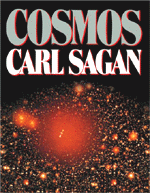
Cosmos comes from a Greek word meaning order. It is the opposite of Chaos. There is a beautiful orderliness to the universe. There are fractal patterns: moons orbiting planets orbiting stars orbiting galaxies orbiting each other. There are billions and billions of stars and galaxies, and the same laws of nature which apply everywhere. And most wonderful of all there is at least one place in the universe where matter has become alive. Humans beings, creatures made from matter, from the same protons and electrons that make up the stars and were once in the stars, are conscious and able to ponder their own destiny. What wonders!
Yet, Dr. Sagan's book is not just a search for order but for meaning. In fact, this is largely how Sagan views the human endeavor in space. Our current forays into space parallel the great historical voyages of discovery. He writes:
 |
| The Eagle nebula |
The surface of the Earth is the shore of the cosmic ocean. From it we have learned most of what we know. Recently, we have waded a little out to sea, enough to dampen our toes or, at most, wet our ankles. The water seems inviting. The ocean calls. Some part of our being knows this is from where we came. We long to return.
If we discover intelligent life on another planet, Sagan thinks we will have a better grasp on what it means to be human. As we continue to learn about the expanse of the universe, we learn what it means to be live on earth. We learn that such a habitable world is precious, but that it pales in comparison with the rest of the universe. As we seek to learn more about the universe, we seek to learn more about ourselves.
Meaning. Perhaps this is the thing that people are searching for. We want to know what our lives are all about, what life itself is all about. When something captures our imagination, be it a sunset, a song, or a beautiful face, and we feel that twinge of restless longing that can never quite be satisfied, it's as if we're on the verge something profound. It seems like the meaning we are looking for is finally within reach, but, like the end of the rainbow, it always remains just ahead of our outstretched hands. And so we keep searching.
Thoughts of space, time, and the cosmos are tantalizing. They are exciting. They fill us with wonder. It's tempting to think that we can find the answers to some of life's most persistent questions out there among the stars. Science has worked wonders and given humans so much. With it, we have fed the masses, eradicated disease, and traveled around the world and into space. Science has answered questions about gravity, the lives of animals, and how our own minds work. What can't science do? Yet, Palmer Joss (character in the film Contact based on the Sagan novel by the same name) reminds us that "Ironically the thing that people are most hungry for, meaning, is the one thing that science hasn't been able to give them."
No matter how long we listen with our radio telescopes among the stars, no matter how many light-years we travel, no matter how much our hearts ache as we gaze at the night sky, we will never find meaning there. Sagan is fascinating, inspiring, and uplifting in his book as he searches for order and meaning. He is also dead wrong. Science can say nothing about the questions that matter most. Allow me an example. It is a scientific fact that if you were randomly inserted anywhere in the universe, the odds that you would be on or near a planet would be less than 1 in 10^33. The odds that you randomly select a place in the universe where there is life is considerably less, much less intelligent life. It would be fair to say that beings such as humans are rare. This is a fact of which modern science makes us acutely aware. Yet Sagan goes on to write, "Every one of us is, in the cosmic perspective, precious. If a human disagrees with you, let him live. In a hundred billion galaxies, you will not find another." I don't disagree a bit, but his statement is one of pure philosophy. He assumes that because something is rare it is therefore precious and ought to be preserved. But mightn't it be the other way around? Might not humans be like ugly recessive mutations in a universe meant to be perfectly smooth and uniform? Wouldn't it then be better if we blew our tiny planet up and squashed conciousness out of existence? Science or nature by itself tells us nothing about the value of our lives. It's worth repeating here part of the GKC quote from my last post. (I think it rather apt here. Sorry for the redundancy.)
Nature does not say that cats are more valuable than mice; nature makes no remark on the subject...We think the cat superior because we have (or most of us have) a particular philosophy to the effect that life is better than death. But if the mouse were a German pessimist mouse, he might not think that the cat had beaten him at all. He might think he had beaten the cat by getting to the grave first...It all depends on the philosophy of the mouse. You cannot even say that there is victory or superiority in nature unless you have some doctrine about what things are superior. You cannot even say that the cat scores unless there is a system of scoring. You cannot even say that the cat gets the best of it unless there is some best to be got.
Orthodoxy, Chapter VII, The Eternal Revolution
If Sagan's logical leap from saying that life is rare to saying that life is precious seems natural to you, that is because you and he are both humans. The conclusion does not come from science, but from the very thing that makes us human. To paraphrase Pascal, our heart tells us what our reason cannot. Science is by no means useless in the pursuit of ultimate truth. The facts of science can challenge our worldview and help us to think in new ways. Philosophically, it did make a big difference when we realized that the earth was not the center of the universe. It makes a difference that our universe is big and not small. It makes a difference that there are beautiful, unexplored worlds out there. It makes a difference that the human spirit is not bounded to this planet alone. But these facts only make a difference because humans are humans. We are influenced by the world we inhabit. At the end of the day, the answers are not going to be found out there, but in the depths of our human hearts. It is ironic that we should look billions of light years away in search of ourselves.
Subscribe to:
Posts (Atom)